
Practical Climate Action Training for People, Communities, and the Nonprofits
and Towns That Serve Them
PROVEN, PRACTICAL APPROACH
Get road-tested, affordable, do-it-yourself solutions for a changing climate that you can launch now!
Start today with ‘8 Steps: Cut Your Carbon Footprint 50%.’
Online Learning. OL 241 Writing Your Local Climate Action Plan:
https://csd-i.org/climate-change/climate-change-action-plan-241/
Center for Sustainable Development: https://csd-i.org
Class Home Page 241
Download Class Documents:
Assignment One Discussion
Assignment One Homework
Magee Example Project Assignment 1
A Field Guide to Community-Based Adaptation.
Field Guide 10.1. How to Do a Participatory Needs Assessment – Workshop Lesson Plan & Illustrations.
Chapter One. Community Needs Assessments and Project Outline. This is Assignment 1.
This first week’s assignment will take longer that any of the assignments over the next 8 weeks. This is why you have three weeks for it. This gives you time to explore the online course structure, download resources, read the discussion, and to engage with a small group of community members who are concerned about climate change and would be willing to participate in a community needs assessment.
This assignment also has two components: a field component (the needs assessment meeting with community members) and a written component (showing the results of the assessment). I would suggest printing this assignment out by downloading it from Downloading Class Documents.
Download Field Guide 10.1 How to Do a Participatory Needs Assessment – Workshop Lesson Plan, and the Magee Project Example from the Download Course Documents. I would recommend role-playing the Lesson Plan with a colleague for practice. Make adaptations to the lesson plan that would be appropriate for your community situation and context.
Find a group of community members that either you or one of your community contacts already has a trusting relationship established with. Set up a 2 hour meeting with eight or 10 community members. Please try and meet with community members that represent the ultimate beneficiaries (mothers, fathers, families, farmers, ranchers – whoever describe the community you are working with); try to avoid basing you assessment on a meeting exclusively with people in higher positions: mayors or city council members for example.
Work through the lesson plan with the group. I like to have an easel with large sheets of newsprint where I can quickly jot down ideas as they are voiced in the discussion.
After the group has come up with a good set of needs/problems, let them have a short coffee break. I will take that 15 minutes to organize the list so that similar things are grouped together on a sheet of notebook paper.
Before the workshop, I take two large sheets of newsprint and draw a matrix in each one of them with two columns and perhaps 12 rows. one column is 1/3 and the other column is 2/3 wide. On the first sheet I transfer the organized list of challenges and underlying causes to the rows which are 2/3 wide. I lay this on a table in a room for the voting process.
Then, have everyone leave the room. Give each one of the participants 10 seeds, or beans, or small stones. Only one person should go into the room at a time to use their seeds to vote on the needs in the empty rows adjacent to the listed items. They should select the needs which THEY feel are the most important. It is their decision if they want to put all 10 seeds in one square or if they want to distribute them around several different problems.
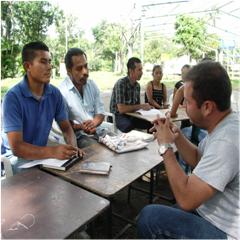
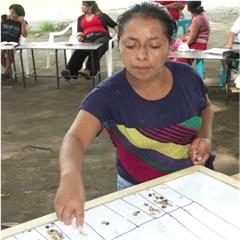
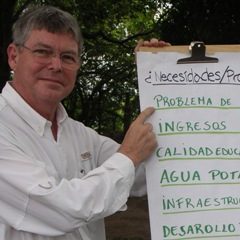
After all the workshop participants have had a chance to cast their votes, count the total seeds in each square. On the second sheet of newsprint with two columns, I quickly write up a prioritized list ordered by the number of votes each problem received. This is a good time for the participants to have an open discussion about the results of the vote.
Important:
You should take a minute alone with the prioritized list and make a determination whether the items on their list are problems or underlying causes.
You should also make the determination if the prioritized list represents two or three unrelated projects such as some health needs and some agricultural challenges . If that is the case, organize the list so that health needs are in one place and agricultural challenges in another.
For the purposes of the course—and your learning experience—I want you to develop a very simple, easily defined project., For unrelated challenges, it would be a good idea to let the participants come to an agreement on which project should be attempted first. In our example above, you could ask them if they would prefer to work on the health component or the agricultural project first.
The full list of needs/problems with the number of votes each received (Photos too please! Attach a few to your email or paste them onto page 2 of your assignment).
See you next week. Copyright © Tim Magee