
Practical Climate Action Training for People, Communities, and the Nonprofits
and Towns That Serve Them
PROVEN, PRACTICAL APPROACH
Get road-tested, affordable, do-it-yourself solutions for a changing climate that you can launch now!
Start today with ‘8 Steps: Cut Your Carbon Footprint 50%.’
We’re currently inviting a small number of organizations to participate in this pilot.
If you’re interested, reply to the email you received or contact:
Tim.Magee@csd-i.org
In this video, Tim gives a two minute summary on what this online workshop is for and how it works. In this program, working side-by-side with him, you will develop a climate action plan in 6 to 8 weeks. Mr. Magee is CSDi’s Executive Director, and the author of A Field Guide to Community Based Adaptation, Routledge, Oxford, England.
Mr. Magee is CSDi’s Executive Director and the author of A Field Guide to Community Based Adaptation, Routledge, Oxford, England.
This short video gives a behind-the-scenes introduction to needs assessments. It also expresses the importance of working closely with community members at the beginning of the process of developing a climate action plan.
It also offers some tips and pointers on how to set up a meeting with 10 or 12 community members and inspire them to discuss climate challenges that they’re facing. You will take careful notes and then, with a simple voting technique, help them to prioritize these challenges and to and to determine which is the most important one for them to start on 1st.
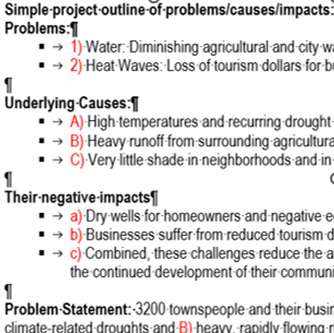
Today, you will take the prioritized list of climate challenges that your community members developed and take the first step in forming a project design. You will rearrange the climate challenges into a formal outline by aligning a climate challenge with the cause of that climate challenge, and with the negative impact it’s having on the community.
I ask that you do this with just two of the community’s challenges. That’s because as we begin researching solutions to these challenges and inserting project activities into the outline, the outline grows considerably, and the project becomes increasingly complex.
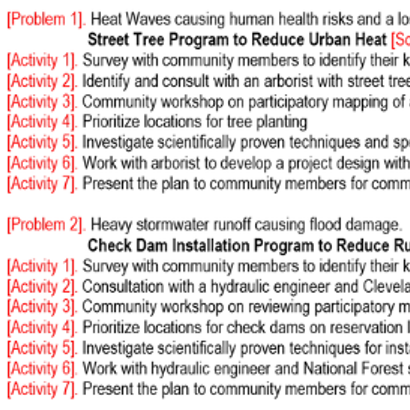
You concluded Assignment Two with a set of community identified problems organized into a simple project outline. You also wrote a short and concise description of the combined problems. Now is your opportunity to develop a theory of how to solve the problems and to begin exploring specific activities that will fulfill your theory.
To find potential climate change solutions, you can use your own expertise about the subject, you can ask colleagues for ideas, and you can perform an Internet search. Chances are very likely that other people have had the same challenge that you are facing, and will have posted their solutions to climate change online.
What if you are a mother in a small town and your children are suffering from recurring heat waves? A member of a US agency comes to town with a plan to help end your children’s suffering. Wouldn’t you want their plan to work?
Suppose that you work for a nonprofit or a local government. You’re hoping to help community members adapt to more frequent extreme weather events. Wouldn’t you want to be successful?
This week you’re going to verify that the programs and activities you chose for your Climate Action Plan will actually work to solve the climate change challenges. You will do a bit of research to see if any scientific studies have been done showing evidence of the effectiveness of your climate adaptation program.
At this point, your project design is well enough developed that you can show it to people, I suggest you share your project with two types of people: community members and a potential foundation donor.
The first people you should show the design to should be the community members that you did the needs assessment with. It only needs to be a brief meeting with just a few of the people. You will be able to find out from them if the project has developed in the direction that they had hoped for.
One reason for arranging a preliminary meeting with a foundation donor is to find out if the project is appropriate for them to partner on. So, before you do any more work on developing the project, a donor meeting will let you find out if you need to make any modifications to be a better fit with the donor.
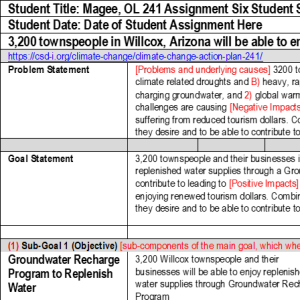
This week you’re going to take your project outline from Assignment 3 and copy and paste it into a logical framework—or logframe. A logical framework approach uses a more sophisticated matrix than your project outline has.
If you’re not used to using a logical framework approach, you should realize that the logical framework is used by all donors. It’s a standardized matrix that allows a donor to quickly see how a project is laid out, the specifics of what you’re going to do to meet the project’s goal, and how you’re going to evaluate if you’ve been successful at meeting your project’s goal.
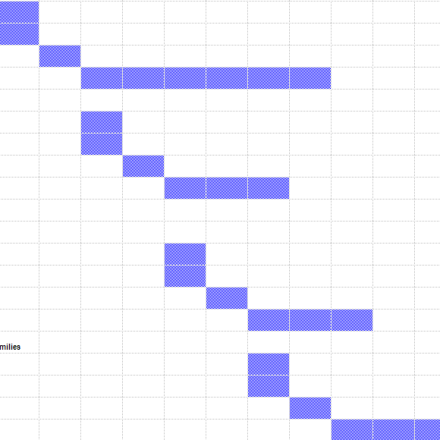
This week begins a very important new step. We will start developing a series of parallel documents. We already have our log frame with all of our activities laid out in a numbered sequence. Over the next two weeks we will transfer this information into a detailed budget and a project schedule.
The reason it’s important to have a series of parallel documents, is that different people in your organization will each be using documents that contain different information, and it’s important that they are all working with parallel information.
So we want the budget to be an exact representation of the log frame, and we want a project schedule to be an exact representation of the log frame too.
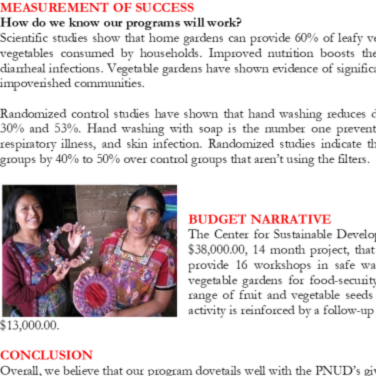
Donors are busy. As enthusiastic as you may be with a lengthy proposal you have written, handing it to a donor may not be the best way to start off your first meeting. Something that I have found is a good alternative is to hand them a 1 ½ or 2 page clearly organized document: a fact sheet. They can scan it for 30 seconds or a minute, and quickly get a good understanding of your project. Properly done, they will also get a sense of your organizational capability.
Using some of the donor ideas in this week’s discussion, make a list of 2 potential NGO partners, and two donors that you could share this working project proposal with next week. We will make an appointment with one donor for next week;
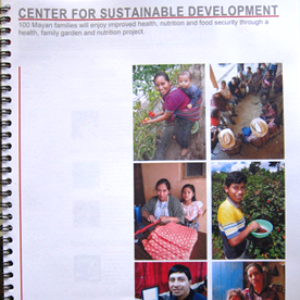
Collect your 12 week’s worth of assignments. Clean them up in Word and in Excel (make sure they look good and there aren’t typos), and print them out carefully. Collect a few of your best photographs of the community that you worked with and print out a single sheet of card stock with 4 or 6 photos and a project title on it for the front cover.
The presentation book of this course clearly shows what your project is about, it shows how we have built sustainability and impact into the project, it shows how we’re going to manage the project successfully, and it gives our audience a sense of our capabilities.
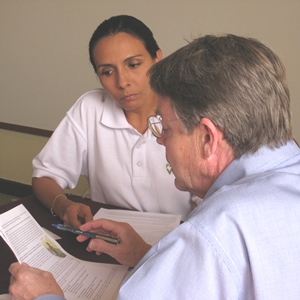
Receiving donor feedback and guidance this week will help you develop your project so that it will be better received when you decide to actually submit it.
A donor will also be impressed that you would seek out guidance from them. It will plant a seed in their mind that you could be someone good to partner with on a project. Much in the same way as we have worked to get a buy-in from our community members, we are now beginning to work to get a buy-in from the people that may fund the project. If they like what they see as the project design evolves, and truly feel that you listened to their ideas and comments, they are going to feel a sense of ownership for the project. This will increase your chances of getting a project funded.
You can also learn more about the full training program here:
Write a Climate Action Plan for Your Rural Community