
Practical Climate Action Training for People, Communities, and the Nonprofits
and Towns That Serve Them
PROVEN, PRACTICAL APPROACH
Get road-tested, affordable, do-it-yourself solutions for a changing climate that you can launch now!
Start today with ‘8 Steps: Cut Your Carbon Footprint 50%.’
How Can You Prevent Climate Change?
Step 1: Have a Climate Conversation.
It’s easy and it’s fun!
Create your message to best fit community perception, needs & values.
A large number of people today may be skeptical of a changing climate—but may very soon be facing increasing challenges caused by the reality of a changing climate. Climate change believers, scientists, and activists can offer assistance in helping skeptics be prepared. But how can we come together to work together positively and effectively?
Those most affected and in the greatest need will be people in marginalized communities, diverse ethnic communities, communities with low government support such as small rural communities, and tribal nations. It is essential that these communities are supported in adapting to the changing conditions.1
Each one of these communities of people is unique and will need a different approach to climate communication. But, one thing is certain: These community members need to be actively involved in the process if they are to be climate-ready.
“Adapting everything we do to a new and changing climate is a shared responsibility. No one person, group, business, or government can do it alone. Yet to date, much of the talk about adapting to a changing climate has happened amongst governments, decision makers, and the business community.
“Climate-Ready Communities: A Guide to Getting Started has been developed to take the climate change adaptation conversation from the boardroom table to the kitchen table. It’s all about supporting communities to have their own conversation about how the things they value will be impacted by climate change, and what they can do to continue to thrive.”1

Write Indigenous Climate Action Plans
8 Week Class
Hands On
How to Write a Climate Action Plan
8 Week Class
Hands On

Fund Your Climate Action Plan
8 Week Class
Hands On
Launch Your Climate Action Plan
8 Week Class
Hands On
Building Meaningful Bridges & Bonds Between Climate Change Believers & Skeptics.
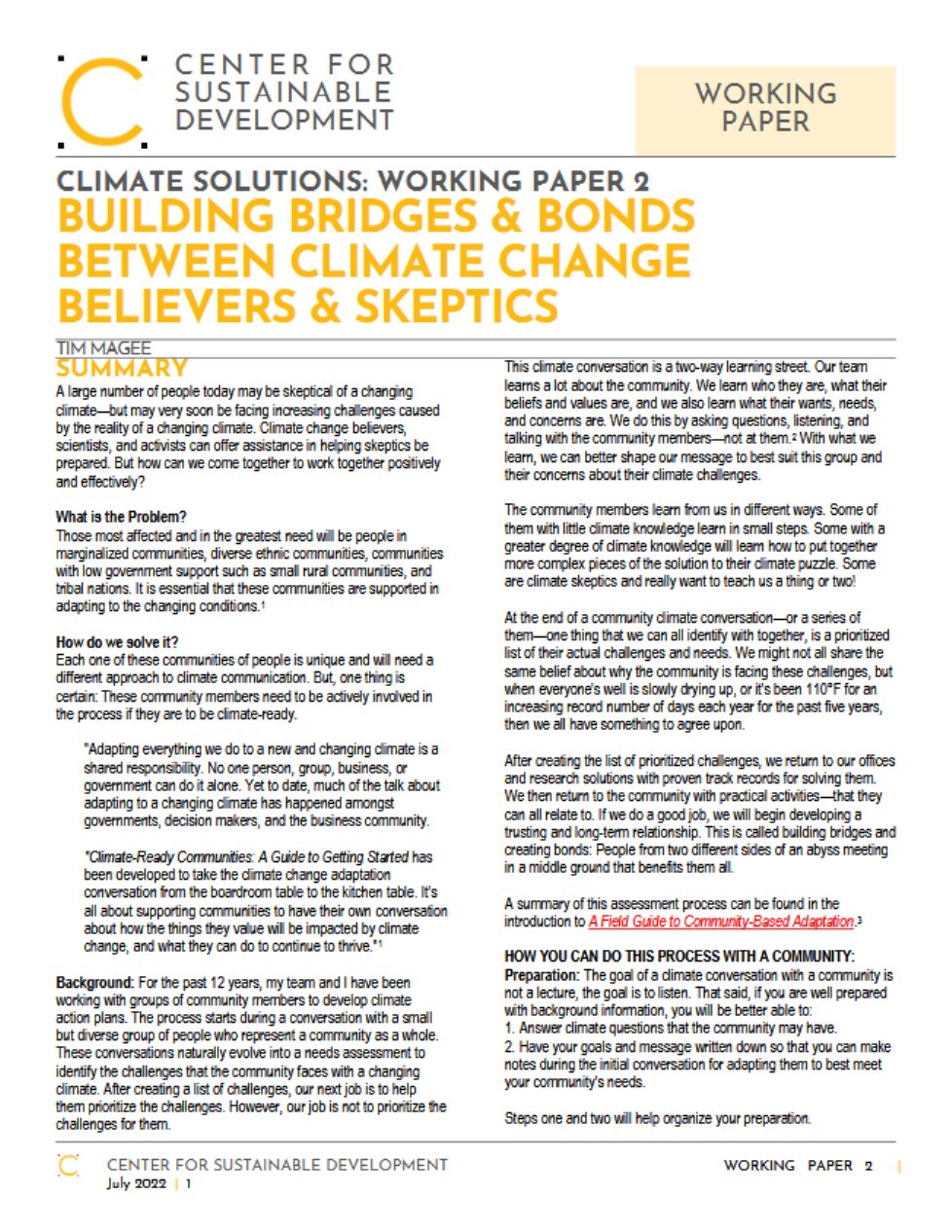
CLIMATE SOLUTIONS: WORKING PAPER 2
8UILDING BRIDGES & BONDS BETWEEN CLIMATE CHANGE BELIEVERS & SKEPTICS
TIM MAGEE
SUMMARY
THE 8 STEPS
A large number of people today may be skeptical of a changing climate—but may very soon be facing increasing challenges caused by the reality of a changing climate. Climate change believers, scientists, and activists can offer assistance in helping skeptics be prepared. But how can we come together to work together positively and effectively?
What is the problem?
Those most affected and in the greatest need will be people in marginalized communities, diverse ethnic communities, communities with low government support such as small rural communities, and tribal nations. It is essential that these communities are supported in adapting to the changing conditions.1
How do we solve it?
Each one of these communities of people is unique and will need a different approach to climate communication. But, one thing is certain: These community members need to be actively involved in the process if they are to be climate-ready.
“Adapting everything we do to a new and changing climate is a shared responsibility. No one person, group, business, or government can do it alone. Yet to date, much of the talk about adapting to a changing climate has happened amongst governments, decision makers, and the business community.
“Climate-Ready Communities: A Guide to Getting Started has been developed to take the climate change adaptation conversation from the boardroom table to the kitchen table. It’s all about supporting communities to have their own conversation about how the things they value will be impacted by climate change, and what they can do to continue to thrive.”1
Background: For the past 12 years, my team and I have been working with groups of community members to develop climate action plans. The process starts during a conversation with a small but diverse group of people who represent a community as a whole. These conversations naturally evolve into a needs assessment to identify the challenges that the community faces with a changing climate. After creating a list of challenges, our next job is to help them prioritize the challenges. However, our job is not to prioritize the challenges for them.
Step One. Write a Climate Footprint Plan to reduce your carbon footprint by 50%. This is very important to do if you want success. The first thing to do in developing your Climate Action Plan is to perform a carbon footprint estimate on your household. I used this great carbon footprint calculator that I found. The link is in the resource list at the end of this document.
This climate conversation is a two-way learning street. Our team learns a lot about the community. We learn who they are, what their beliefs and values are, and we also learn what their wants, needs, and concerns are. We do this by asking questions, listening, and talking with the community members—not at them.2 With what we learn, we can better shape our message to best suit this group and their concerns about their climate challenges.
The community members learn from us in different ways. Some of them with little climate knowledge learn in small steps. Some with a greater degree of climate knowledge will learn how to put together more complex pieces of the solution to their climate puzzle. Some are climate skeptics and really want to teach us a thing or two!
At the end of a community climate conversation—or a series of them—one thing that we can all identify with together, is a prioritized list of their actual challenges and needs. We might not all share the same belief about why the community is facing these challenges, but when everyone’s well is slowly drying up, or it’s been 110°F for an increasing record number of days each year for the past five years, then we all have something to agree upon.
After creating the list of prioritized challenges, we return to our offices and research solutions with proven track records for solving them. We then return to the community with practical activities—that they can all relate to. If we do a good job, we will begin developing a trusting and long-term relationship. This is called building bridges and creating bonds: People from two different sides of an abyss meeting in a middle ground that benefits them all.
A summary of this assessment process can be found in the introduction to A Field Guide to Community-Based Adaptation.3
HOW YOU CAN DO THIS PROCESS WITH A COMMUNITY:
Preparation: The goal of a climate conversation with a community is not a lecture, the goal is to listen. That said, if you are well prepared with background information, you will be better able to:
Steps one and two will help organize your preparation.
Join 15,000 individuals, and members of nonprofits and local governments: Subscribe to
Climate Solutions.